
How do I care for my Calatheas? - An insight into my plant room.

Today it will be a bit more personal, as I will tell you about the conditions I have, how I care for my Calatheas and how I deal with problems.
Let's start with some general data
I have about 100 plants, or at least that's the number I stopped counting at. Sometimes a few are added, sometimes one or two die. And yes, even with advanced experience, you can't save every plant; that's perfectly normal and okay.
All my Marantaceae (and Kaempferia) currently live in a room of about 15 square meters with two windows facing east.
In addition to the approximately 100 plants, there are also 3 cats living in the household, who initially quite diligently ate the plants - but furtunately they have stopped doing so now.
Non-toxic houseplant for cats Non-toxic houseplant for cats Non-toxic houseplant for cats
What are the basic conditions here for my Marantaceae?
Due to the building's structure, I generally struggle with high humidity here, which is why I often run a dehumidifier. This usually allows me to keep the humidity at 50-60%. If I could, I would actually like to lower it even further.
The misconception that Marantaceae require extremely high humidity is unfortunately very persistent. The fact is, however, that neither you nor the plants benefit from consistently high humidity levels above 60%. Therefore, let me reiterate: 45-60% is perfectly fine for Marantaceae.
The temperature in the plant room is usually around 22-24°C, but in summer it can of course be a little higher.
The plants on the windowsill actually have the best spot of all, which is why I often call it the VIP area. All the others in the room don't get much natural light, especially now in winter.

That's why I've now equipped the entire room with additional lamps, which provide light to the majority of the collection for 12 hours a day.
I am personally convinced of the quality of 'Sansi' light bulbs. It's definitely worth keeping an eye out for them, as they are often on sale on Amazon.
But I also really like the lamps from 'Barrina'. They are super practical for shelves, offer various mounting options and can be connected in series (saving on cable clutter). Those lamps are also not very expensive when you get them on sale.
Speaking of saving money: For those who have concerns about their electricity bill, I can only say that using grow lights has not caused any noticeable increase in my electricity costs.

Regarding the substrate: I now have all my plants in self-watering systems using the 'Green Jungle Mix' (this is also available either cheaper in a double pack via www.floragard.de, or occasionally on sale on Amazon).
There were several reasons for me to switch to self-watering, but the biggest reason was the time saved when watering.

But how do I actually water my plants?
As mentioned above, I frequently run a dehumidifier, which (unfortunately) also collects a fair amount of water. My watering can now consist of a mixture of water from the dehumidifier and tap water. I mix them in a 2:3 ratio, which ultimately gives me a conductivity of approximately 350µS.

Even with the 2:3 mixture, my pH value is far above pH 7, so I now adjust the water to pH 5.8.
Unfortunately, subsequent measurements revealed that even after adjusting the pH with phosphoric acid, it doesn't remain stable for long and rises again after just one day. Therefore, I keep it slightly below pH 6; I wouldn't recommend lowering it further than pH 5.8.

My Marantaceae are generally very thirsty plants, so I usually have to add water twice a week, making sure that the water level indicator is only at the middle level.
Speaking of watering: When, how and with what do I feed my plants?
Admittedly, I was skeptical at first when my sister told me about the 'Hesi' products. My first thought was that they are simply being hyped online - for whatever reason.
However, I decided to give it a try and I must admit that 'Hesi' actually convinced me.
Therefore, all Marantaceae now regularly receive 'SuperVit', 'Power Zyme' and occasionally 'Hesilicio'.
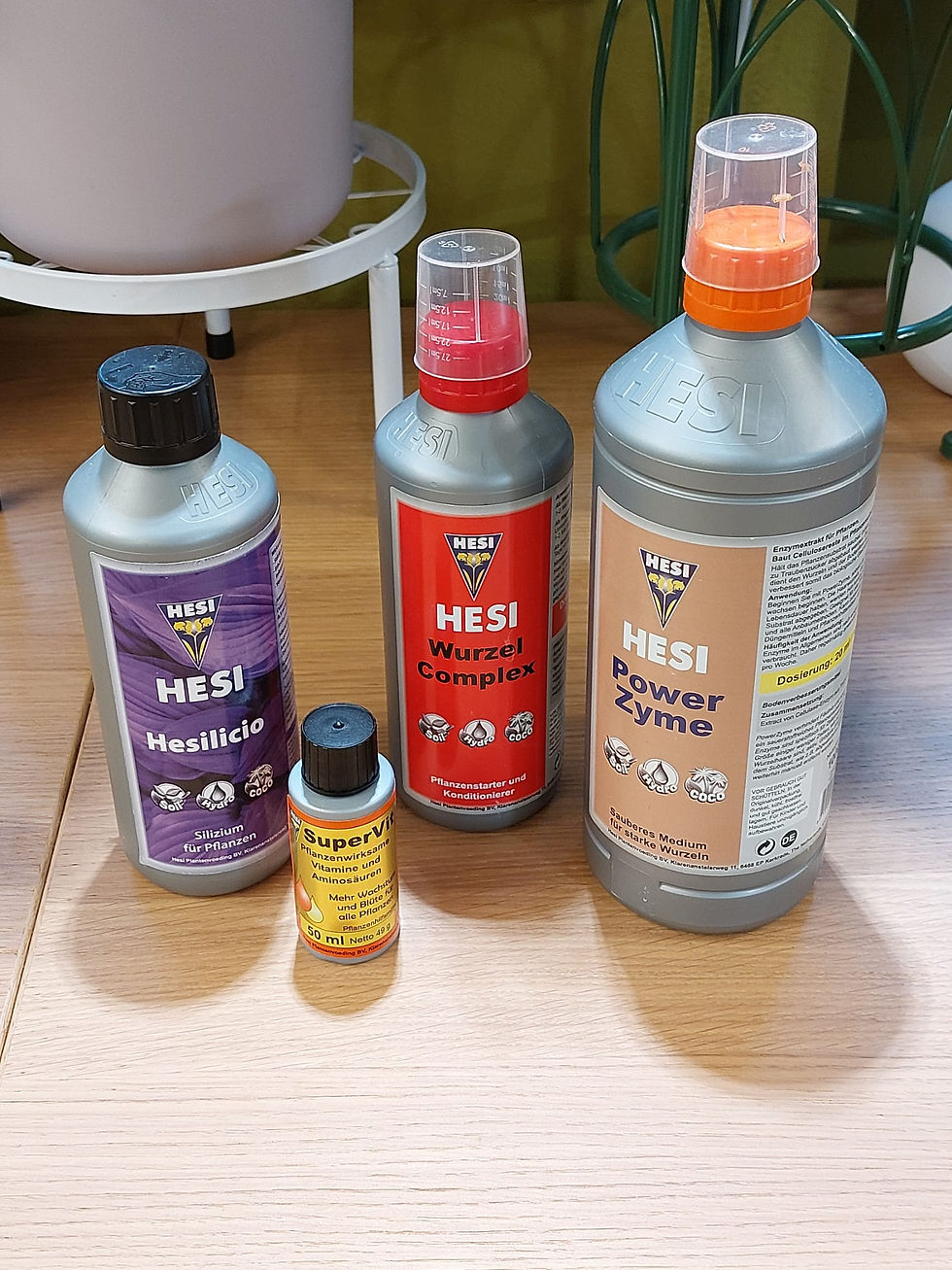
Plants that have just been repotted also receive 'Root Complex', which is supposed to reduce stress. Whether this actually helps, or whether I've simply become more experienced at repotting from soil to mineral substrate over time, I can't say for sure.
In addition to the 'regular' food, I fertilize every 4-5 weeks, year-round. I use 'Houseplant Elixir' from 'Hesi' and, if time allows, try to thoroughly rinse all pots or stones before fertilizing.

When do I repot plants and how do I know what size pot to use?
I usually repot new Marantaceae immediately after purchase, if possible. I've had the best results with this method and can check the roots right away.
Furthermore, I have the impression that this only creates one stressful period, allowing the new plant to settle in peacefully without being disturbed and stressed again after a few weeks. However, this is of course just my personal feeling and experience, not a fact.
I repot all other specimens throughout the year, whenever necessary.
Repotting Calathea Leopardina Repotting Calathea Leopardina Repotting Calathea Leopardina Repotting Calathea Leopardina
For plants that are newly moved from soil to mineral substrate, I keep the water level just above the minimum for the first few days and observe the reaction to it.
Sometimes it's recommended to keep no water in the reservoir at all and only flush the substrate every few days. To be honest, that seemed too complicated and time-consuming to me, so I tested it as described above and found it to be successful. After all, you don't always have to overcomplicate things, do you?
However, choosing the right pot size is more important than many might think. The pot should be as small as possible, but as large as necessary. This means the roots should have enough room, but not an excessive amount of free space.
I generally repot Marantaceae in smaller self-watering pots than the size they were purchased in. For example, plants bought in 19cm pots usually go into 17cm self-watering pots because the pot with soil is simply much too large for the amount of roots.
What about pests?
New plants go straight into the shower and get a thorough cleaning with lukewarm water and potash soap. Always. For example, with these products:
Soft soap against spider mites on Calathea Soft soap against spider mites on Calathea
Because of my cats, even though they now only rarely and sporadically attack my plants, I don't use any insecticides at all. It's simply too risky for me, even though the majority of my collection is actually inaccessible because it's on the shelf. But safety first!
That's why I regularly release beneficial insects, like predatory mites or lacewing larvae. I usually combine the following, depending on the purpose:
Lacewing larvae, if I discover larger thrips and as an effective 'immediate action'
I use Amblyseius Swirski when I see very small, young thrips. However, Swirski don't survive for very long, so I use them more as an 'aggressive immediate action'.
Amblyseius Cucumeris is my go-to predatory mite, and these mites last a long time - sometimes a good 6-8 weeks. I use them almost continuously, primarily as a preventive measure.
I also occasionally use Neoseiulus Californicus as a preventive measure, but mainly against spider mites.
For German readers, I can recommend the online shop www.gruenteam-versand.de. Delivery is always very fast, and the predatory mites and lacewing larvae have always worked diligently. I've ordered from other suppliers before, some of which were more expensive, and I didn't receive any live larvae/mites. Annoying!
How do I deal with young, weakened, or sick specimens?
For me, the absolute game changer in this matter is quite clear: moss! Since I started putting plants in moss, regardless of the reasons mentioned above, the probability that they will form new roots, regrow or 'just' recover has increased dramatically.

Additionally, I use various greenhouses to significantly increase the humidity for these candidates.
Whether it's the more attractive ones from Ikea or a purely functional greenhouse, they all retain humidity very well. In my opinion, even the Ikea ones don't require any additional sealing.
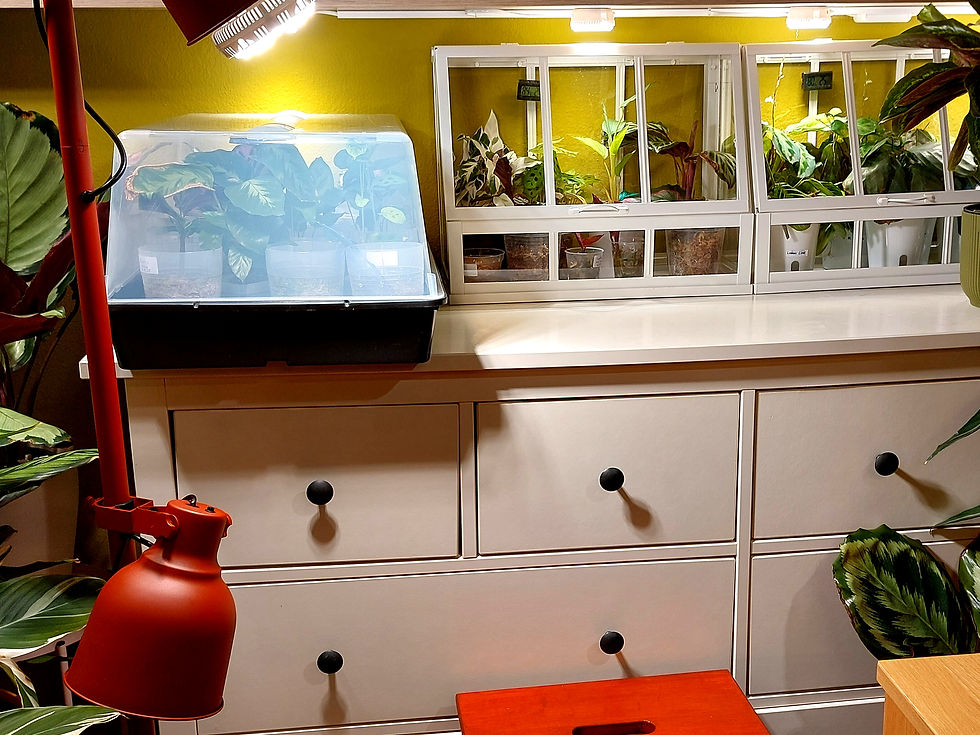
This first glimpse into my plant room is of course not a guide, but merely serves to show how I care for my Calatheas, the conditions under which they live, and the products I use. Because sometimes the question arises: 'How do you actually do that?'
And for other interesting topics, including those based on facts, you can find many more posts here in our blog overview.
Comments