
What is the ideal humidity for your Calatheas?

Dry, brown, or yellow leaf damage is often attributed to low humidity.
But what lies behind such damage and what humidity do Marantaceae really need?
What are the 'natural' conditions?
Referring to the actual natural conditions, namely the climate in the rainforests, one can really assume a very high humidity of around 90% here.
Here with us (in the European market), many Marantaceae come from the Netherlands.
According to our research, the relative humidity during cultivation (i.e., when the plants are still very small) is also around 80-90%, but it is probably reduced to about 75% during the growth phase.
However, the plants do not come directly from cultivation to us, but first stay - for an indefinite period - in garden centers, supermarktes, etc.

It was not easy to find exact figures regarding the relative humidity at the retailers. Especially since, for example, supermarkets or hardware stores that are not specialized in selling houseplants would certainly not be able to provide such information.
In garden centers, as far as we could find out, the humidity is probably around 60% to best meet the needs of the wide variety of plants and their different requirements. And possibly also to create conditions that are similar to those in our own rooms.
Which conditions are often mistakenly recommended?
Very often we read 'The ideal humidity for Calatheas is over 80%' and based on their original habitat, this statement may not be completely wrong.
Marantaceae sold in the trade are not dug up from the rainforest and then offered for sale, but come from cultivation.
And as noted above, the plants are neither in their growth phase nor with various dealers in an environment with a constant humidity of over 80% or even a controlled relative humidity at all.

One should also basically keep in mind what such recommendations for extremely high humidity in living spaces mean for humans, so let's take a quick look at that as well.
What conditions are actually optimal for one's own home?

It's easy to see that the ideal values for humans in the home are up to 60%, and even in the bathroom, the humidity should not exceed 70%.
Permanently high humidity can, for example, lead to mold growth in the apartment, which in turn can pose a significant risk to one's health.
So what is the ideal humidity for Calatheas?
It would therefore seem reasonable to conclude:
Our spatial conditions and the (false) recommendations/assumptions would fundamentally make it impossible to keep Marantaceae as houseplants.
BUT: Healthy Marantaceae do very well with a (for us) normal relative humidity of 40-60%!
So what should be done to achieve a relative humidity of 40-60%?
at too high humidity:
use a dehumidifier
-> health risk due to mold growth
ventilate regularly
with too low humidity:
Do NOT mist plants!
-> Water collects on the leaves and increases the risk of fungal growth.
-> As a result, the humidity only increases for a very short moment, so it does not effectively solve the problem.
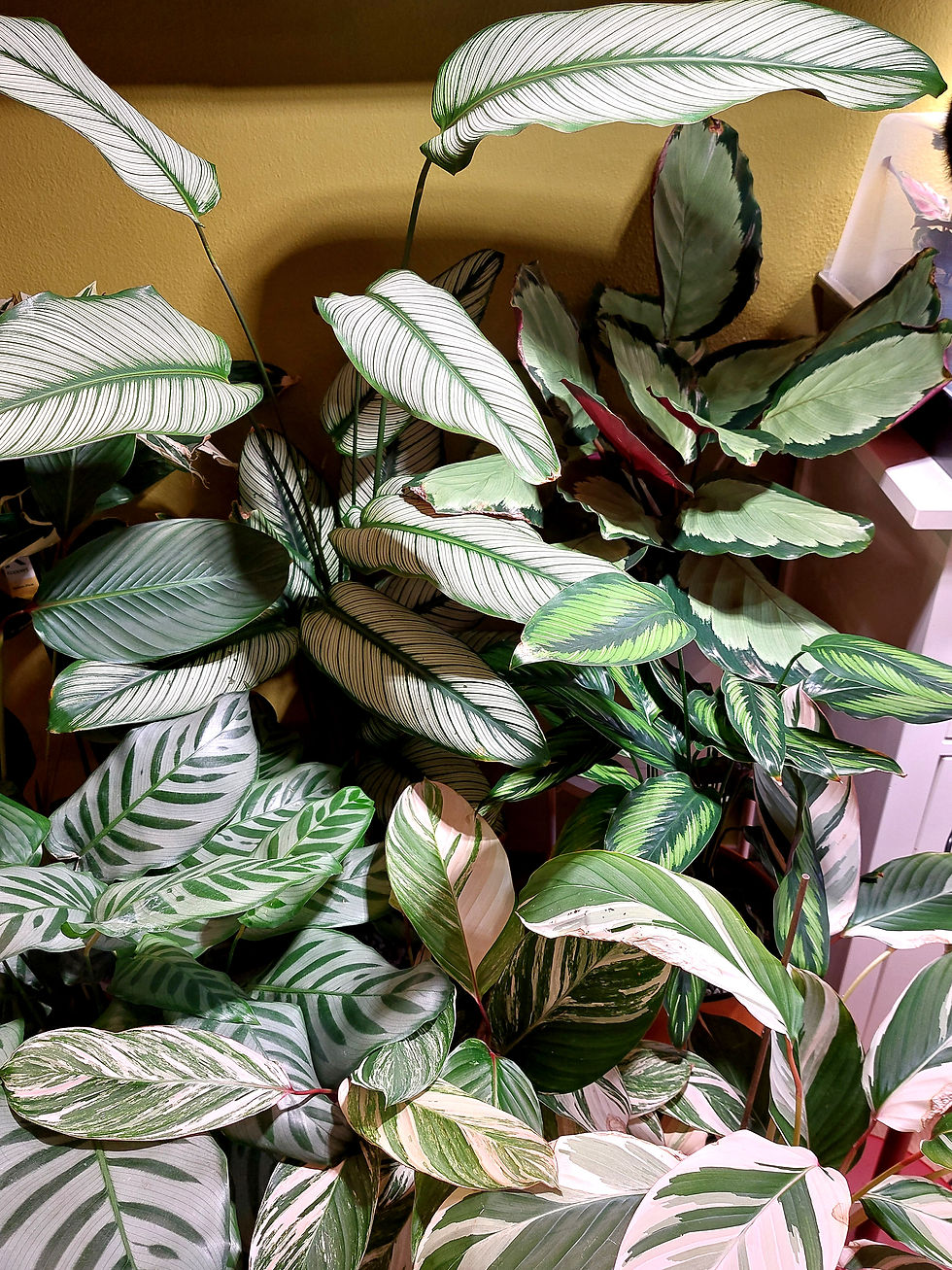
Grouping plants increases the humidity in the immediate vicinity of the plants.
A container of water on the radiator can increase humidity in the winter.
Hanging the laundry near the plants to dry helps.
Place a bowl filled with stones and water under the plant pot (no direct contact with the plant).
A greenhouse can be useful for small or weak plants to provide a consistently (very) high humidity.
If the rooms generally have very low humidity (e.g. in Germany most likely due to building conditions), one should consider using a humidifier (to reach 40-60%, also for one's own health, not just because of the plants).
Which symptoms are now being mistakenly attributed to humidity?
Amazingly, almost all leaf damage is often blamed on low humidity.
No matter the leaves:
are dried out or have dried edges
have yellow or brown spots
are rolled up
are hanging
are not 'sleeping' or 'praying' (not raising their leaves in the evening)
and much more
But the fact is that all of this is rarely the result of low humidity.
The exact causes should always be considered individually, but in most cases, the causes of such damage include:
unsuitable substrate
unsuitable casting behavior
damaged roots
pest infestation
unsuitable location
When is it advisable to significantly increase the humidity?
There are situations in which specimens require extremely high humidity, but for the reasons mentioned above, we do not want or are able to increase the humidity in our living spaces that drastically.
This is, for example, the case with:
stressed plants
-> after division
-> after import
-> possibly after repotting
-> maybe with pests
plants or rhizomes that are supposed to sprout or form roots
In such cases, it is advisable to provide a small greenhouse for the plants. If you have a single plant that is infested with pests such as spider mites, you can simply cover it with a transparent bag or something similar.
Conclusion:
Contrary to popular belief, Marantaceae do not need a relative humidity of over 80%.
A normal humidity of 40-60% is completely sufficient!
Various leaf damages are in rare cases the result of too low humidity.
There are exceptional cases where deliberately and drastically increasing humidity, for example with a greenhouse or a bag, is advisable.
Here you can find our blog overview if you want to learn more.


Comments